REVIEW · ANTWERP
Guided Antwerp Port Tour, in your Car or Minibus
Book on Viator →Operated by Antwerp Port Tours · Bookable on Viator
Port Antwerp runs on scale and side stories. This guided drive packs big-name industry with human details, from Zaha Hadid’s Havenhuis to working gates on the Scheldt.
What I really like is how the guide makes the port readable, not random. I enjoyed the way you get visual cues for how the harbor works, especially around lock-master signals and the choreography that keeps ships, tugs, and barges moving.
One thing to consider: it’s an industrial route. The tour isn’t recommended for people with serious respiratory diseases, and you’ll want good weather for the drive-and-stop rhythm.
In This Review
- Key highlights you’ll remember
- Making the port click: why this drive feels different
- Price and logistics: private up to 15, in your car or minibus
- Droogdokkenweg and Havenhuis Vantage: Zaha Hadid’s dry-dock contrast
- Oosterweel contrast drive: the medieval spire next to Europe’s biggest wharf
- Scheldelaan duality: petro-chem titans and the graffiti flood wall
- Boudewijnsluis and the workhorse locks: small gates with big responsibility
- Lillo: ghost village windmill to Lillo Fort’s geese and gunpowder tales
- Berendrecht Lock and Dock 910: giants at the gate, and a terminal in motion
- Antwerp-North hump yard and the container canyon: rail brains and fruit fast lanes
- Who this tour suits best
- Should you book Antwerp Port Tours in your car or minibus?
- FAQ
- How long is the Antwerp Port Tour?
- What is the price and group size?
- Is this tour private?
- What language is the guide?
- Do we need our own vehicle?
- Is it refundable if I cancel?
Key highlights you’ll remember
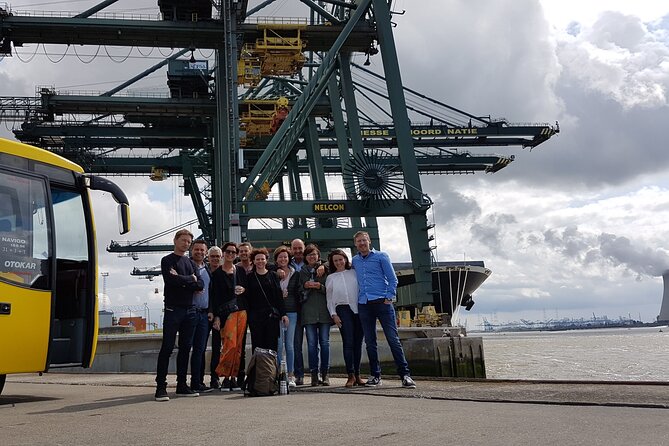
- Havenhuis Vantage meets historic dry docks: a photo stop with design commentary and a maritime museum angle
- Oosterweel contrast drive: a tiny medieval church beside Europe’s biggest wharf
- Scheldelaan duality: petro-chemical industry on one side and a long graffiti flood wall on the other
- Boudewijn–Van Cauwelaert locks: small by port standards, yet vital for everyday supply lines
- Lillo Fort time-warp: geese on the ramparts, fishermen’s houses, and wartime tales
- Rail hump yard finale plus reefer fruit terminal: the road-rail-river system, then the speed of exports
Making the port click: why this drive feels different
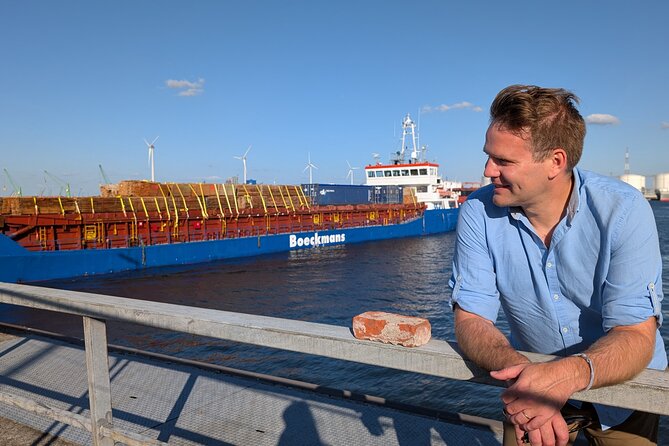
This tour works because it teaches you a way to look. Antwerp’s port can feel like a blur of cranes and containers, but here you’re taught what to notice first: the gates, the flows, and the places where the port touches neighborhoods and history.
The format helps too. You’re not stuck on a bus in a fixed seat staring out a window. You move from point to point for short stops and quick explanations, so you can connect what you see with what you’re told. It’s the difference between collecting facts and understanding how the machine runs.
And it’s guided by people who clearly like Antwerp. In past groups I’ve read about, guides such as Laurens and Niki (multilingual, including Luxembourgish) bring a conversational tone. They don’t drown you in dates; they point at shapes, systems, and surprises and explain why they matter.
If you like ports as living workplaces, this tour hits the sweet spot: industry as a story you can follow.
Price and logistics: private up to 15, in your car or minibus
This is priced per group at $314.42, for up to 15 people. That’s good value if you’re traveling with family or friends, because you’re not paying a per-person rate for a topic that’s hard to appreciate from a distance.
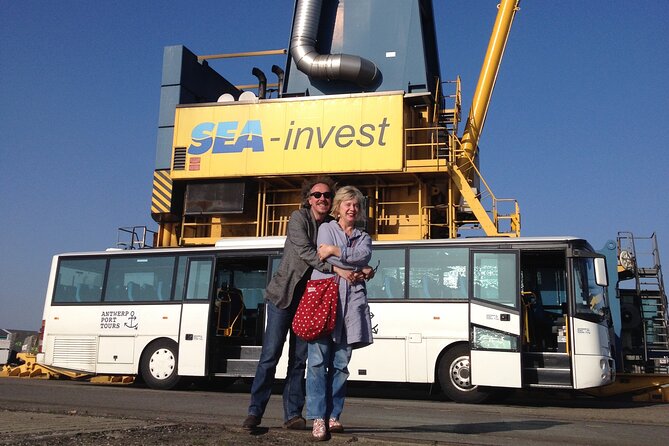
The other big factor is the transport style. You ride in your own car or minibus, and your guide will join you in the vehicle you use. The meeting point is Kinepolis Antwerpen (Groenendaallaan 394, 2030 Antwerpen), and the tour ends back there.
Two practical notes to plan around:
- You’re outdoors or near working areas for several stops, so bring layers and closed shoes.
- Because it’s a private group tour, the experience is built around your group size and timing, not a large public schedule.
It’s offered in English, and you’ll receive a mobile ticket at booking. Since it’s a private activity, only your group participates.
Droogdokkenweg and Havenhuis Vantage: Zaha Hadid’s dry-dock contrast
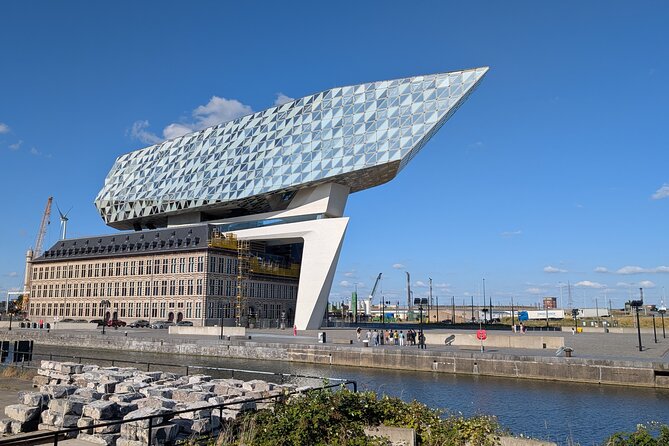
The tour starts at Droogdokkenweg, where you disembark opposite Havenhuis Vantage. The building is striking: a diamond-glass hull look that seems to float above a 19th-century structure. That mix of bold contemporary design and older industrial bones is exactly what makes this port tour feel like more than a view from a highway.
This is also a “future-facing” stop. The adjacent dry docks are being transformed into the city’s Maritime Museum, and your guide explains the design choices and what the museum will bring to the space. Even if you don’t plan to linger in museums later, this viewpoint gives you an instant map of how Antwerp preserves industrial heritage while repurposing it.
Expect it to be mostly about seeing. The stop is short (around 10 minutes), but it’s built for photos and orientation. Admission is listed as free for this stop, so you can focus on enjoying the location without extra ticket worries.
Possible drawback here: if you hate quick stops, this part may feel like a brief teaser. The payoff is that it sets up everything else you’ll see—especially the dry-dock thinking behind what follows.
Oosterweel contrast drive: the medieval spire next to Europe’s biggest wharf
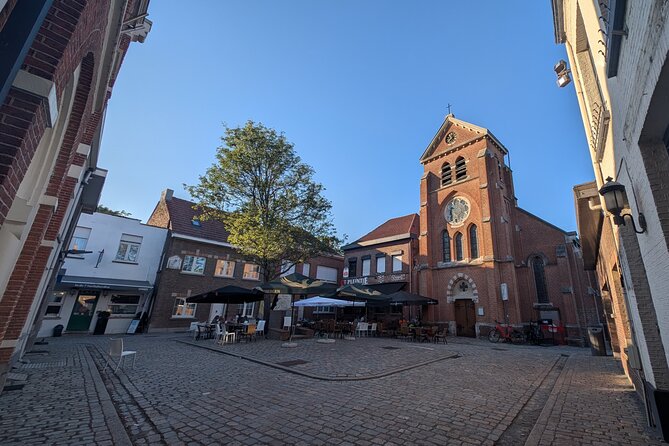
Then you’re in motion, gliding past a tiny 15th-century church at Oosterweel. It’s easy to miss in the bigger picture, but the guide uses it like a spotlight: this is a medieval landmark, and right beside it is a construction zone on a massive scale.
Why it matters: Oosterweel is tied to Antwerp’s long infrastructure story, where tunnel segments for the Ring closure are being cast. Your guide connects the dots from older river parishes to post-war port expansion and the huge multi-year overhaul happening now.
This drive-by works well because it forces contrast. One side is small, old, and local. The other side is industrial engineering pushing outward. It’s the port learning to grow without asking permission from the past.
The stop time here is brief (around 10 minutes), but the explanation is the point. You leave with a better sense of Antwerp’s geography: the port doesn’t just sit by the city; it has swallowed space over generations.
Scheldelaan duality: petro-chem titans and the graffiti flood wall
Next comes Scheldelaan, and the tour turns your car into a moving show. On one side you get stainless tanks, cracking towers, and steam plumes from one of Europe’s biggest chemical clusters. On the other side, you’ll see a kilometre-long flood wall covered in color for an annual international graffiti contest.
That graffiti wall might look purely artistic at first. The guide frames it as more than street style: it’s tied to safety and infrastructure, and the port’s need to protect the land. Your view shifts from “art on concrete” to “human expression within strict systems.”
Your guide also points out how pipelines run under the roadway like hidden arteries. That’s a key lesson for the whole tour: much of the port’s action is underground or behind barriers, and your job as a visitor is to learn the signals.
This is one of the most memorable sections because the contrast is so clear. If you’re traveling with kids, it’s also a section where you’ll get quick reactions: sparks of color and steel in the same frame.
Boudewijnsluis and the workhorse locks: small gates with big responsibility
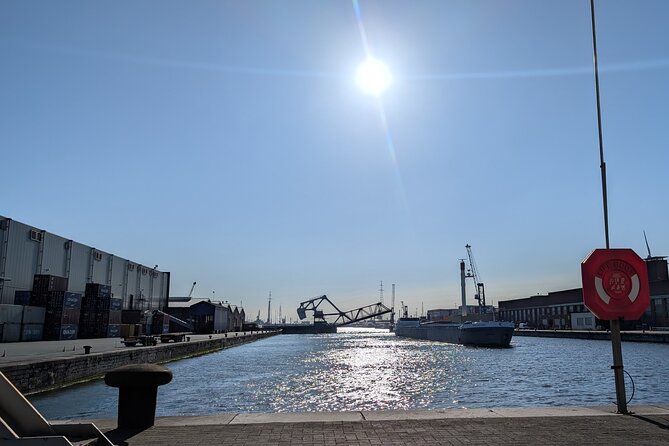
At Boudewijnsluis you step out by De Vaarkom basin. You’re flanked by chemical stacks on one side and the twin Boudewijn–Van Cauwelaert locks on the other. Yes, these locks are modest by port standards, but they’re vital for the kind of daily movement that keeps refineries and supplies fed.
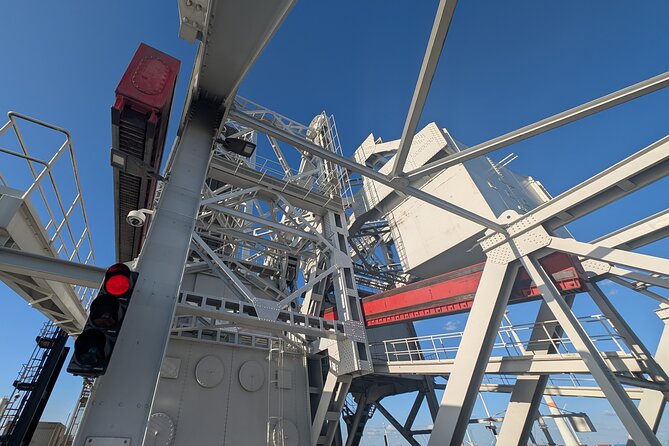
Here, the tour becomes practical. Your guide explains how lock operations work—down to how you can read signals from the lock-master—and points out details you might miss otherwise. There’s talk of bow thruster turbulence underfoot, and the logic behind the “workhorse” gates that keep supply lines running day and night.
You may also see tugs nudging short-sea freighters through the narrow sluices. Even without a dramatic ship moment, the storytelling makes the space feel alive. Locks can look like concrete and lines on a map, but up close you understand how much coordination sits behind them.
This stop is also short (around 10 minutes), and admission is listed as free. The best use of your time is to look for the small cues: movements near the gates, rope work, and the way tugboats position themselves.
Lillo: ghost village windmill to Lillo Fort’s geese and gunpowder tales
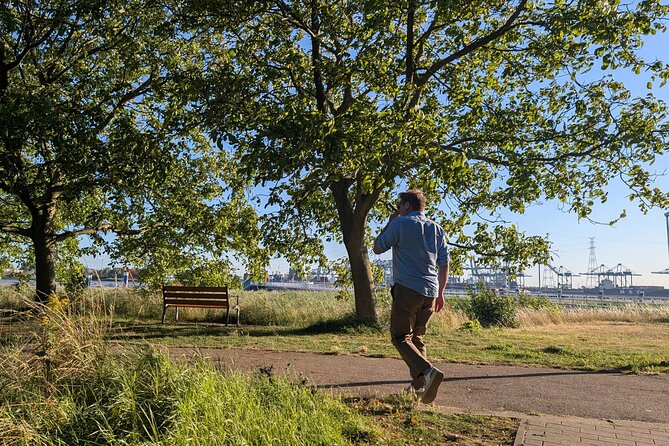
Lillo enters like a time machine. First you do a drive-by at the solitary brick windmill that marked the disappeared village of Lillo. The guide uses it to show how port sprawl works in real life: with about 30 km already “under your wheels,” you’re still only halfway into the port’s territory. The point is scale, but also memory—entire hamlets were bought out and dismantled as docks pushed inland.
Then you go to Lillo Fort, where the tour trades smokestacks for cobblestones. This is the most “people and place” stop on the route. A gaggle of geese greets you on the grassy ramparts, and you can picture fishermen’s houses and a small dock that feel tied to older routines.
Your guide layers in history: Spanish sieges, smugglers, and the community that held onto identity even with the chemical cluster across the dike. The contrast hits hard in a good way. Antwerp’s port isn’t only metal and logistics; it’s also communities coping with change.
Expect about 30 minutes here, with admission listed as free. If you want one stop that’s easier to enjoy than the pure engineering scenes, this is it.
Berendrecht Lock and Dock 910: giants at the gate, and a terminal in motion
As you roll along the service road, the Berendrecht Lock yawns open beside you. This is the main doorway to the docks beyond, and the guide gives you the choreography behind it—tugboats, line-handlers, and the tug-and-barge dance that keeps huge ships safe.
The promise here is scale. If you catch a vessel moving, you might see a 300-metre bulker or a container ship gliding past, with hull plates that look taller than buildings. Even if nothing passes at that exact moment, the lock’s size and the guide’s details make it a highlight.
Then you step (briefly, about 10 minutes) to a riverside overlook near PSA quays at Dock 910. From here, you see multiple “frontiers” at once:
- Container choreography right in front of you
- The Berendrecht and Zandvliet locks just behind
- The Belgium–Netherlands border line mid-stream
- The twin cooling towers of the Doel nuclear plant beyond
It’s a lot to take in, which is why a guided view matters. Without commentary, it’s easy to see only containers. With it, you see systems meeting geography.
One practical consideration: this is a working port area, so expect things that look loud and busy even at rest. If you prefer calm sightseeing, take a breath before you move on.
Antwerp-North hump yard and the container canyon: rail brains and fruit fast lanes
The tour keeps moving toward the “how goods get sorted” side of the port. Near the end, you get an Antwerp-North hump yard drive-by, peering down at a marshalling yard that can handle up to about a thousand wagons reshuffled each day.
Your guide explains gravity-shunting like a controlled rollercoaster. Locomotives push mixed trains over the hump, wagons roll downhill, and laser sensors plus track retarders help brake each car into its assigned consist. Then computer-controlled switches route cars toward places like Germany, France, or the Ruhr.
If you like transportation nerd stuff, this part pays off. It’s less about visual drama than about understanding how a huge rail system can still feel orderly.
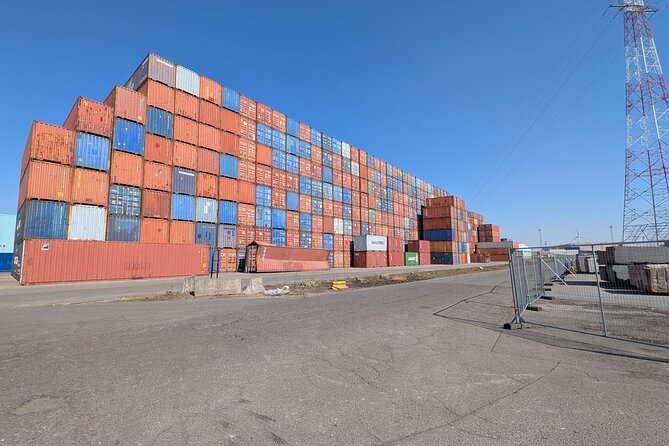
Then comes the container canyon finale (about 5 minutes). You thread through multicoloured container stacks where you can read the seals on the boxes. On one side loom granite blocks awaiting export. On the other side is a refrigerated “reefer” setup tied to what’s described as Europe’s largest fruit terminal, handling bananas and citrus that move from ship toward supermarket quickly.
That last burst matters because it shows the port at both ends: heavy exports and everyday food. You finish with a sense that the port isn’t only for steel and chemicals. It’s also the logistics behind what ends up on your table.
Who this tour suits best
This is a great match if you:
- Want to understand port operations beyond general sightseeing
- Like a guided mix of architecture, engineering, and human stories
- Have a group up to 15 and want a private format
It’s also a good option for families with older kids, since the advised minimum age is 12. If your group includes someone who enjoys photos, you’ll have multiple opportunities at dry docks, locks, and terminals.
It’s not a good fit for people with serious respiratory diseases, since you’re in an active industrial environment.
Should you book Antwerp Port Tours in your car or minibus?
I think this is worth booking if you want the port to make sense fast. The value isn’t only the price per group; it’s the way the guide helps you see the “invisible” parts of the port—pipelines under roads, lock signals, rail sorting mechanics, and how industry connects to towns like Lillo.
Book it if you can handle short stops and you’re okay being in a working area. Skip it if your idea of a great day is quiet, low-traffic walking and minimal industrial exposure.
If you go, aim for a day with good weather. The tour notes that it needs it, and the experience runs best when you can comfortably do the drive-and-disembark rhythm.
FAQ
How long is the Antwerp Port Tour?
The tour lasts about 2 hours 30 minutes.
What is the price and group size?
It costs $314.42 per group, with a maximum group size of up to 15 people.
Is this tour private?
Yes. It’s a private tour/activity, so only your group participates.
What language is the guide?
English is the offered language, and you’ll get a mobile ticket.
Do we need our own vehicle?
Yes. The format is in your car or minibus, and the guide will board your bus during the tour.
Is it refundable if I cancel?
Free cancellation is available. You can cancel up to 24 hours in advance for a full refund, and if the experience is canceled due to poor weather, you’ll be offered a different date or a full refund.