REVIEW · PORTO
Cruise Shore Excursion – Private Tuk Tuk Tour to the Historic Center
Book on Viator →Operated by Portuk · Bookable on Viator
Porto in a tuk tuk feels made for first-time orientation. You’ll roll past church façades, gardens, river viewpoints, and photo stops without spending your whole day fighting parking and traffic. I like the private guide attention and the way the route mixes classic landmarks with practical local context, like where to eat and how to time your next stop. The one thing to consider: while it’s sold as private, there have been reports of being mixed onto the same tuk tuk when the operator overbooked.
The tour format also helps if you want a lot of Porto in a short window. I especially like the hilltop river views plus the smooth “see, stop, look, move” pacing that works well for cruise days. You also get a port wine glass (more like a quick pour at a viewpoint than a full sit-down bar stop). A drawback to plan around: cobblestones can be bumpy, and the tuk tuk seats are small, so it’s not ideal if your group needs more space or has back issues.
If you’re booking with a cruise schedule, this is the kind of shore excursion that can work very well. Pickup is offered from the cruise port areas (Leixões Port, Matosinhos Port, and Doca Norte), and the tour starts no later than 1 hour after the ship arrives. Still, because timing depends on dock logistics and the operator’s communications, I’d plan extra buffer time and keep your phone ready for last-minute changes.
In This Review
- Key highlights to look forward to
- Why this Porto tuk tuk tour works for cruise days
- Pickup and timing: how the tour fits your dock schedule
- The tuk tuk experience: comfort, cobblestones, and group size
- The historic center route: what you’ll see and why it matters
- Sea-and-industry themed stops and granite landmarks
- Passeio das Virtudes: the river view stop you’ll remember
- Cordoaria Garden (Jardim de João Chagas): design with a rope-maker story
- Torre dos Clérigos: baroque icon and the climb choice
- Livraria Lello: famous Art Nouveau exterior and major queue reality
- Churches and tiles: Igreja do Carmo and Igreja dos Carmelitas
- Praça and palaces: Bolsa, Mercado Ferreira Borges, and the Infante monument area
- Churches you associate with Porto: São Francisco and the golden interior effect
- Bridges and river viewpoints: from Douro engineering to perspective
- Serra do Pilar: circular church plan and a terrace view over Porto and Gaia
- Practical advice on what to prioritize during the short stops
- Alcohol, the port wine glass, and how it’s served
- Price and value: what you’re paying for
- Who this Porto tuk tuk tour is best for
- Should you book this private tuk tuk tour in Porto?
- FAQ
- How long is the private tuk tuk tour to Porto’s historic center?
- What’s the price per person?
- Do I get pickup from the cruise port?
- Is the tour offered in English?
- Are monument entrance fees included?
- Is there a mobile ticket?
- What drink is included?
- Is this tour truly private?
- Does the tour require good weather?
Key highlights to look forward to
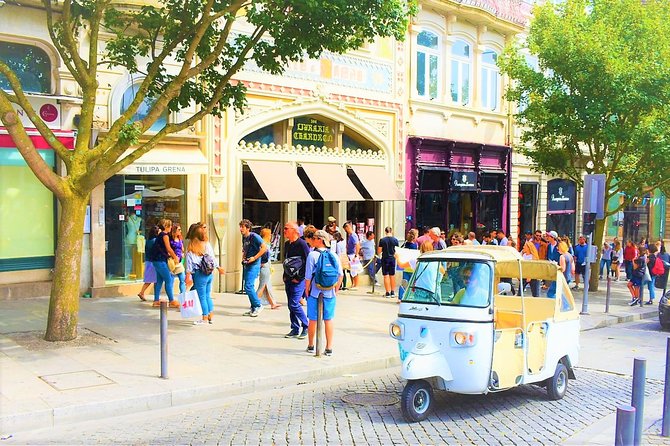
- Private tuk tuk cruising through narrow streets where cars and buses struggle
- English-speaking driver/guide and live commentary that ties sights to Porto’s story
- Hillside viewpoints like Passeio das Virtudes with wide views over the Douro
- Iconic monuments in the historic core, including Torre dos Clérigos and Livraria Lello (entrance fees not included)
- Art and design stops such as Cordoaria Garden and the Stock Exchange Palace’s famous interior space (entrance fees not included)
- Port wine glass served during the tour, usually as a quick tasting moment
Why this Porto tuk tuk tour works for cruise days
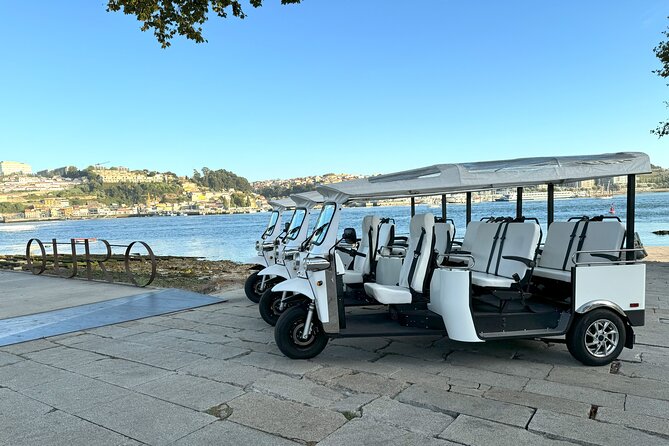
This tour is built around the reality that cruise passengers often have one big question: can I see enough Porto without burning the day on transit and lines. The tuk tuk format answers that fast. Porto’s center is hilly, and streets tighten up toward the historic core. A small vehicle can get you closer to the places you actually want to walk from, and your guide can use the time between stops to give context instead of just shuttling.
You also get a solid structure: a live guide narrative plus a local guide presence. You’re not just collecting postcards. You’re learning what each area was for, who built what, and why certain streets and buildings matter. That makes it easier to pick where you want to spend extra time after the tour ends.
I especially appreciate that the itinerary includes both viewpoints and “walk-a-few-minutes” landmarks. Porto’s river drama is easiest to understand from the heights. Then you can come down and feel the city’s scale in plazas and church interiors, even if your actual entry tickets are limited.
You can also read our reviews of more boat tours in Porto

Pickup and timing: how the tour fits your dock schedule
Pickup is offered from the main gate at Leixões Port, Matosinhos Port, and Doca Norte. The tour starts no later than 1 hour after your ship arrives, and you’re expected to provide ship details at booking like the ship name, docking time, disembarkation time, and re-boarding time.
This matters because the route depends on you being ready on time. Some reviews praise guides who showed up promptly, including guides named Gonçalo and Ana, with clear communication when docking times changed. Others complain about coordination hiccups, including cases where the pickup time wasn’t confirmed smoothly.
My practical advice: treat this like a timed appointment. Be ready at the gate a bit early, and double-check your meeting point on arrival day. If your cruise changes terminals, the operator should be able to adjust, but you should stay proactive.
The tuk tuk experience: comfort, cobblestones, and group size
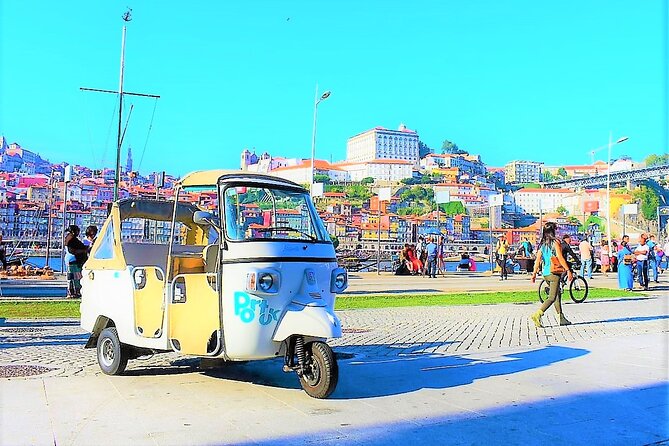
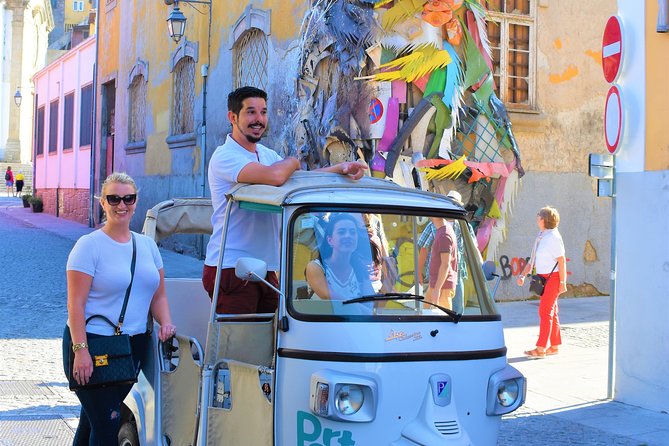
The tuk tuk is one of those travel choices that is either perfect or annoying, depending on your body and your expectations. The big win is access. You can reach viewpoints and tight streets without the slow grind of getting stuck behind buses.
The tradeoff is ride comfort. Porto’s historic streets can be cobblestoned, and several comments point out that bumps are part of the deal. There’s also a clear “small vehicle” limit: one review notes that the tuk tuk wasn’t suitable for three people and felt uncomfortable for the whole tour.
If your group includes more than two people, it’s worth thinking carefully about vehicle fit and how long you’ll tolerate being close together. If you have mobility limits, some guides reportedly adapt well, but you should still expect short transfers and a bit of uneven ground when you step out.
The historic center route: what you’ll see and why it matters
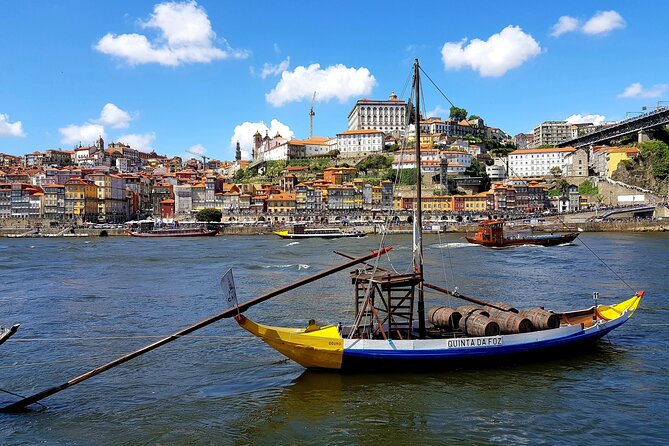
Your tour covers a broad sweep of Porto, mixing landmarks that are easy to recognize from photos with spots that tell you what the city was built on: the river, trade, religion, and craftsmanship.
Sea-and-industry themed stops and granite landmarks
Early on, you’ll get a set of stops tied to Porto and Matosinhos’s seafaring and industrial heritage. One sculpture’s design references fishing through a net-like structure, and the support poles are painted to resemble local smokestacks and lighthouses. It’s a quick way to anchor the tour in the ocean economy that shapes the region.
Then you’ll hit a hexagonal granite tower with a red balcony and lantern. There’s also mention of an annex building with plastered white walls. These kinds of stops don’t just look good on camera; they give you “Porto texture” that you miss if you only focus on the famous church and plaza names.
Passeio das Virtudes: the river view stop you’ll remember
Passeio das Virtudes is one of the clearest payoff moments. From the lane, you look out over the Douro River toward the mouth bar. In the foreground you’ll see the Fountain of Virtudes and terraces that drop down toward São Pedro de Miragaia. Along the river, the former Customs House building adds that trading history layer.
This is also a good moment for a quick breather. The stop is short (about 10 minutes with free admission), but the view is the point. If you only have one “big photo” stop, make it count by planning what angle you want before you step off the tuk tuk.
Cordoaria Garden (Jardim de João Chagas): design with a rope-maker story
Cordoaria Garden, also called Jardim de João Chagas, is tied to rope-makers who lived and worked in the area for about 200 years. In the 1800s, the municipality transformed the surrounding plaza into a public garden under a project by the German landscaper Emile David.
You’ll see statues (including Ramalho Ortigão and António Nobre) and sculptures that were added later, including work by Juan Muñoz. The garden is small enough to walk and absorb quickly, which fits a cruise-day tempo.
This is the stop that often surprises people. It’s not a monument you must queue for. It’s a calm, human scale break inside the busy historic center.
Torre dos Clérigos: baroque icon and the climb choice
Torre dos Clérigos is Porto’s signature tower, a baroque work by Nicolau Nasoni built in the first half of the 1700s. The climb is 240 steps. The viewpoint from the top is the reward, but it’s a real effort, so you’ll want to decide early if you’ll go up.
Here’s the practical catch: the tower visit isn’t included, so you’ll pay the monument entrance separately if you want the full experience. If you skip the climb, you’ll still get the landmark context and street-level atmosphere.
Livraria Lello: famous Art Nouveau exterior and major queue reality
Livraria Lello is known for its Art Nouveau façade with neo-Gothic details and for an interior with a dramatic stained-glass skylight and a famous red staircase. The library building dates from 1906, and it’s the kind of stop that people plan around months in advance.
But the entrance is not included, and tickets can mean lines. One cruise-day tip from a review: if you want inside time, you must buy a skip-the-line ticket online, because regular lines can be huge and you don’t have enough time during a short shore excursion window.
So think of this as a two-part decision:
- Do you want the classic interior photos badly enough to plan for timed entry?
- Or do you want the façade and photo moment only?
Either way, it’s worth seeing. Just don’t assume you’ll casually step in without a plan.
Churches and tiles: Igreja do Carmo and Igreja dos Carmelitas
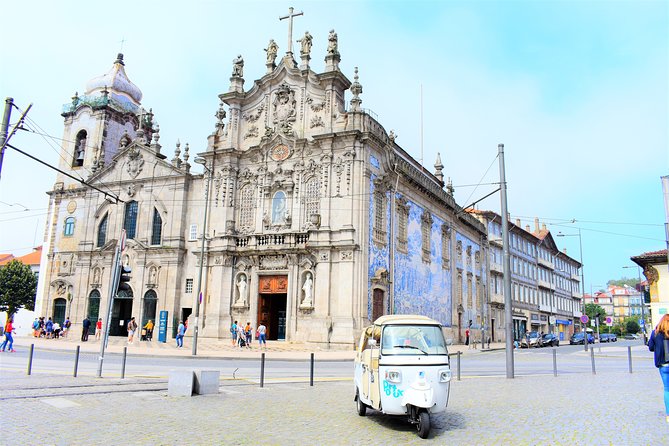
Porto’s religious architecture is a key part of the city’s visual identity. Igreja do Carmo is a national monument with rococo-style interior carvings and tile work on the lateral façade (covered with tiles in 1912). The tile drawings were designed by Silvestre Silvestri and are linked to the cult of Nossa Senhora (Our Lady).
Igreja dos Carmelitas is also a national monument. It dates to the seventeenth century, with a classical façade and an altarpiece described as porto rococo. This is the kind of stop where the outside alone doesn’t tell the full story—if you have energy to step inside, it’s usually where the payoff is.
Some monument entrances aren’t included, so expect to pay at least for some interiors if you want full access.
Praça and palaces: Bolsa, Mercado Ferreira Borges, and the Infante monument area
Your route includes the area with Mercado Ferreira Borges and Palácio da Bolsa in the historic center. There’s also a small garden and a Monument to the Infante D. Henrique, commemorating Portuguese navigation and faith, with the monument’s timeline starting in 1894 and finishing in 1900.
Palácio da Bolsa (Stock Exchange Palace) is a national monument built in 1842 in neoclassical style. Its major highlight is the Arabian Room, and the building functions as a cultural and conference center.
Then you’ll pass or stop by Mercado Ferreira Borges, an iron-architecture market built in 1885 and renovated into an entertainment venue (Hard Club is mentioned). It’s another “porto industrial craft” moment: metal structures and trade history, not just old stone.
Churches you associate with Porto: São Francisco and the golden interior effect
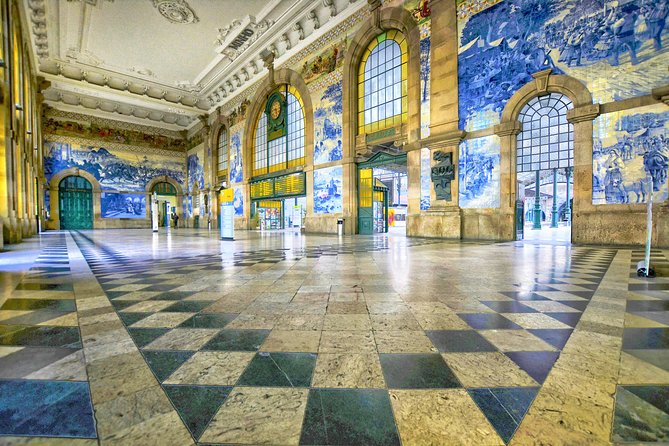
Igreja de São Francisco is the city’s most important Gothic temple. Construction began in the fourteenth century, and its interior is gilded from the seventeenth and eighteenth centuries. That gilded woodwork earned comparisons to the Church of Gold.
It’s also noted for a Tree of Jesse and for catacombs. This isn’t the place to rush if you like visual intensity, but it can be a lot to take in, so give yourself a few minutes to let it sink.
Again, monument entry isn’t included, so check what you want to pay for in advance. If you’re trying to manage costs, you can still get the big exterior impression and move on.
Bridges and river viewpoints: from Douro engineering to perspective
Porto’s river makes every view feel like a story. Your tour includes major bridge sightlines and engineering history.
You’ll see Arrábida Bridge described as a reinforced-concrete arch bridge with six lanes of traffic between Porto and Vila Nova de Gaia. It was concluded and inaugurated in 1963, engineered by Edgar Cardoso, and at the time it opened it was the largest concrete-arch bridge in the world (with a main span of 270 meters).
There’s also another signature iron bridge stop: built in 1886 by Portuguese engineer Teófilo Seyrig, based on Eiffel’s disciple, and designed as two overlapping iron decks. Today, the upper deck carries the Metro of Porto connecting areas between Porto’s Cathedral region and Vila Nova de Gaia.
These aren’t just “look at the bridge” moments. They reinforce how the region connected trade routes and city growth over time.
Serra do Pilar: circular church plan and a terrace view over Porto and Gaia
Mosteiro da Serra do Pilar is a World Cultural Heritage site. Construction started in 1538 and finished around 1670. The story includes religious use, then involvement during the Civil War of 1832–1834, followed by repairs and recovery efforts later.
The church has a circular plan, with a dome and a balcony, and the cloister is circular with 36 Ionic columns, described as the only example in Portugal. The best part is the terrace: you can see the riverside area of Porto and Gaia, plus the historic center, and even the Cathedral and D. Luís I bridge from the viewpoint.
This is one of the best “just look around” stops in the whole route because it ties the entire city together in one glance.
Practical advice on what to prioritize during the short stops
This tour is paced for breadth, not deep museum time. That means you should decide ahead of time what matters most to you.
If you care about interiors:
- Plan for entrance fees at Torre dos Clérigos and Livraria Lello, and likely other monument entries depending on what you choose to enter.
If you care about photos and orientation:
- Focus on viewpoints like Passeio das Virtudes and Serra do Pilar terrace.
- Use the church façades and plaza moments to decide where you might return later.
If you care about food:
- Ask your guide for lunch ideas before you leave the center. One review mentions a guide recommending what to order for a local sandwich, plus providing an estimate for the walk back to port. That kind of inside timing is gold when you’re squeezed by a cruise re-boarding window.
Alcohol, the port wine glass, and how it’s served
You get an alcoholic beverage: a port wine glass. The important detail is how it’s delivered. Instead of a long winery-style stop, it’s more likely poured from a bottle during a pause at a viewpoint or lookout.
That keeps the tour on schedule and avoids the time cost of finding a bar. It also makes it easier to keep moving, so you don’t feel like you swapped a sightseeing window for a drink stop.
Price and value: what you’re paying for
At $106.93 per person for about 3 hours 30 minutes, you’re paying for three things that matter in a cruise setting:
- Private tuk tuk access through narrow, hilly streets
- Live commentary and local guide context that turns stops into a coherent story
- Time efficiency so you can see a lot without exhausting walking on cobblestones and steep grades
Is it “cheap”? No. But it’s not priced like a full-day luxury private vehicle either. For many cruise passengers, it’s a cost-effective way to get a first pass at Porto and then decide what to return to on your own time after you get your bearings.
Just factor in potential extra costs for monument entrances. Torre dos Clérigos and Livraria Lello specifically note that admission isn’t included.
Who this Porto tuk tuk tour is best for
This is a strong match if you:
- Have one limited day in Porto and want an orientation tour
- Want to reduce walking on hills and stairs
- Enjoy history tied to real places, not just isolated facts
- Like the idea of a guide giving eat/drink/explore advice for after the tour
It’s less ideal if you:
- Need very smooth rides (cobblestones can feel rough)
- Are a larger group that needs more space than a small tuk tuk provides
- Want lots of shopping time; the stops are meant for efficient sightseeing
Should you book this private tuk tuk tour in Porto?
If you’re booking because you want a fast, guided introduction to Porto’s center, I think this is a good choice. The tuk tuk format is the real value: you get to see more than you’d manage on foot, and you get a narrative that makes the city easier to understand.
Book it if you can commit to the pacing and you plan for entrance fees for the big-ticket stops. Also, confirm pickup details for your exact terminal and docking changes. And if private truly matters to you, it’s smart to ask how they handle vehicle assignment so you don’t get surprised on the day.
If you want, tell me your cruise docking time and whether your group has mobility concerns or plans to enter Torre dos Clérigos and Livraria Lello. I can help you decide the best way to spend your time during the stop windows.
FAQ
How long is the private tuk tuk tour to Porto’s historic center?
It lasts about 3 hours 30 minutes.
What’s the price per person?
The price is $106.93 per person.
Do I get pickup from the cruise port?
Yes. Pickup is offered from the main gate at Leixões Port, Matosinhos Port, and Doca Norte.
Is the tour offered in English?
Yes, it’s offered in English.
Are monument entrance fees included?
No. Monument entrances are not included. The itinerary notes several stops where admission is not included, including Torre dos Clérigos and Livraria Lello.
Is there a mobile ticket?
Yes, the tour uses a mobile ticket.
What drink is included?
You receive a port wine glass as part of the tour.
Is this tour truly private?
It’s listed as private, meaning only your group participates. However, there is at least one report of the tuk tuk being shared due to overbooking, so it’s smart to be alert to how your vehicle will be assigned.
Does the tour require good weather?
Yes. The experience requires good weather, and if it’s canceled due to poor weather, you’ll be offered a different date or a full refund.