REVIEW · BERLIN
Explore Berlin Shore Excursion: Top Attractions Private Tour from Warnemuende
Book on Viator →Operated by Insider Tour Berlin · Bookable on Viator
Berlin hits hard, even in one day.
This private shore excursion turns your stop in Warnemünde into a focused day of landmarks tied to Germany’s political twists—from the Reichstag to the Berlin Wall’s most emotional memorial pieces. I like the calm logistics (dockside pickup, a driver who keeps you on schedule), and I really like how the guide work is built around clear context, with guides like Phil and Brian Bell using on-hand visuals to make World War II and postwar decisions easier to grasp. One consideration: with 12 hours and many quick stops, you’ll want to be okay with walking fast and spending less time lingering in each place.
In This Review
- Key Points That Matter Before You Go
- Why This Warnemünde to Berlin Tour Works in 12 Hours
- Port Pickup and Private Transfers: The Real Time-Saver
- Price and Value: What You’re Actually Paying For
- Reichstag Building and the Glass Dome: Power, Ruin, and a View
- East Side Gallery: Art on the Berlin Wall’s Most Famous Stretch
- Soviet Memorial Tiergarten: A Quiet Stop With Real Weight
- Museum Island in 20 Minutes: Why It’s Worth the Speed
- Führerbunker: The Dark Details Under the City
- Checkpoint Charlie: Cold War Tension at Street Level
- Memorial of the Berlin Wall (Bernauer Strasse): Escape Stories You Can Feel
- Brandenburg Gate and Unter den Linden: Reunification Through One Monument
- Bebelplatz and Gendarmenmarkt: From Censorship to Culture Squares
- Who This Tour Fits Best (and Who Might Want a Different Approach)
- My Booking Advice: Should You Go?
- FAQ
- What is the duration of the Berlin shore excursion from Warnemünde?
- What’s the price per person?
- Is this tour private?
- Do I get picked up at the cruise port, and how does the meeting work?
- What language is the tour guide?
- Is food included?
- Is admission included for the major stops?
- Is the tour focused only on one period of history?
- What’s the cancellation option if plans change?
Key Points That Matter Before You Go
- Dockside pickup plus a separate guide keeps the day moving without confusing handoffs.
- WWII and Cold War storytelling is the point, not just sightseeing snapshots.
- Most admissions listed are free, so you’re paying mainly for time, transport, and expert interpretation.
- You get both Wall art and Wall memory: East Side Gallery plus Bernauer Strasse’s escape stories.
- It’s designed for shore timing, with a worry-free transfer back to your ship.
Why This Warnemünde to Berlin Tour Works in 12 Hours
If your cruise day in the Baltic gives you one chance at Berlin, this style of private tour can be a smart fit. You’re not trying to solve Berlin with a phone map while coordinating ship reboarding times. Instead, you get a driver for the long in-between parts and an English-speaking guide once you’re in the city.
The best part for me is how the day has a theme: Berlin’s political story, from government power to wall division and reunification. You’ll see the symbols most visitors chase, but you’ll also get the thread that ties them together.
At $1,075.31 per person, it’s not the kind of tour you take on a whim. It’s priced like a private, high-touch shore day—so you’ll get the most value if your group is tight (family or a small circle) and you care about history explained well, not just photo ops.
You can also read our reviews of more private tours in Berlin

Port Pickup and Private Transfers: The Real Time-Saver
This tour is built around shore-excursion sanity. Your driver meets you dockside in a modern air-conditioned vehicle/minibus, then handles the private round-trip transfer to Berlin. Along the way, you’re not waiting around for public transit or negotiating taxis while your ship time ticks closer.
A separate expert guide meets you in Berlin, and that handoff is where these tours often succeed or fail. Here, the setup is meant to keep you from losing momentum. The experience also uses a mobile ticket, which helps when you’re moving through multiple sites.
Practical tip: wear shoes you can handle for a long day of short, concentrated walks. Most stops are around 12–20 minutes, with one longer stop near the Berlin Wall memorial site.
Price and Value: What You’re Actually Paying For
That per-person price sounds steep until you think about what’s included. You’re paying for private door-to-dock transport, private guiding, and an air-conditioned mini-bus for moving between sites across central Berlin. You’re also not budgeting for many admissions because the tour lists free admission tickets for each major stop.
If you’re traveling solo, you may feel like this is a luxury. If you’re traveling as a couple or a small group, the price becomes easier to justify—especially because you’re buying time, not just destinations. In a shore setting, “time” is what you can’t replace if something runs late.
One more value factor: the guide quality. The reviews spotlight guides like Phil and Brian Bell as standouts, including Phil’s strong World War II explanations and Brian Bell’s professional, charming approach. When a history-heavy day lands well, that’s worth a lot.
Reichstag Building and the Glass Dome: Power, Ruin, and a View
Your day starts at the Reichstag building, a site that carries a lot more than architecture. Built in 1894, it’s linked to major political eras—the Weimar period, the Nazi rise tied to the 1933 fire, and damage from World War II. It’s one of those places where you can’t fully understand modern Germany without knowing what happened here.
The modern glass dome designed by Norman Foster is the big visual payoff. Even in a short stop, it gives you that “this is the present, built on the past” feeling, with panoramic views that help you read Berlin from above. The contrast—symbolic heavy history plus a bright modern structure—works extremely well for first-timers.
Time reality check: this is about 15 minutes on the clock. Don’t expect a long, slow museum-style visit. Do expect a guided overview that helps you place what you’re seeing into the larger political timeline.
East Side Gallery: Art on the Berlin Wall’s Most Famous Stretch
Next you’ll hit the East Side Gallery along the Spree River. This is the part of the Berlin Wall you’re most likely to recognize instantly—an open-air gallery with more than 100 murals by artists from around the world.
The tour frames it as both a freedom symbol and a reminder of division. That matters, because the gallery can look like street art first, and history second, unless your guide gives you the context. Expect photo-friendly stops, but also expect political and human rights themes discussed as part of the reunification story.
Time is short here too—about 20 minutes—so come ready to make quick choices: where you want to stand for photos, and how much you want to read on the spot. If you like art, you’ll probably want more time, but the benefit is you’ll get the Wall story without turning your day into an all-museum marathon.
A few more Berlin tours and experiences worth a look
Soviet Memorial Tiergarten: A Quiet Stop With Real Weight
In Tiergarten, the Soviet War Memorial is a solemn tribute tied to the Battle of Berlin in 1945. You’ll see the imposing statue of a Soviet soldier holding a raised sword, along with a well-kept cemetery for thousands of Soviet soldiers.
This is one of the most reflective stops on the tour. It’s also one of the most useful for understanding why Berlin’s postwar story isn’t only about Western choices. The guide explains the memorial’s construction and why Soviet forces are tied to the city’s liberation narrative—then you’re left to absorb what that means in a physically meaningful place.
Expect about 15 minutes. It’s not a long visit, but it’s long enough to understand the purpose and to see the scale of the cemetery. If you’re sensitive to war-related memorials, this is the stop that will feel the most direct.
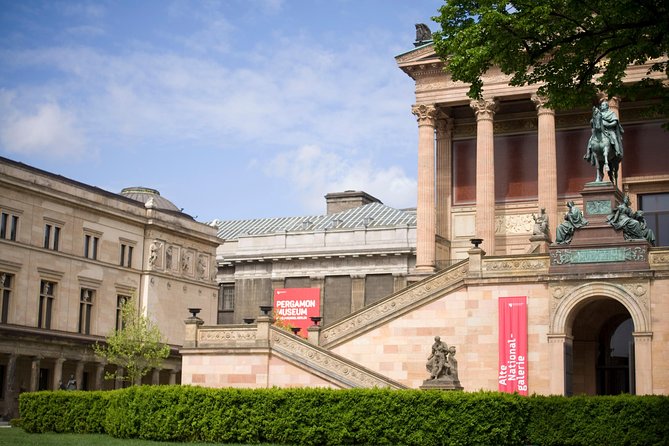
Museum Island in 20 Minutes: Why It’s Worth the Speed
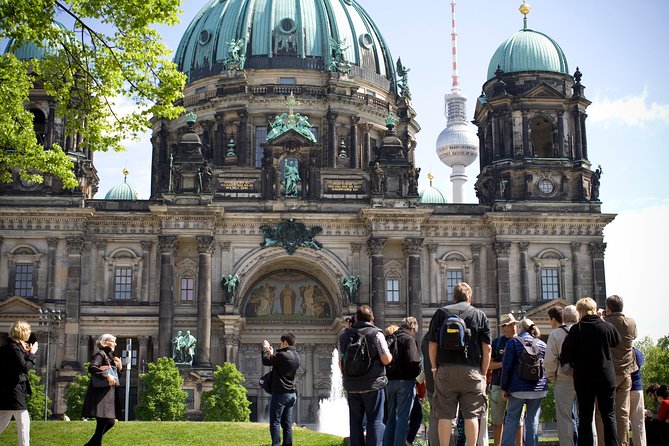
Museum Island (Museumsinsel) is a UNESCO World Heritage site with five major museums on an island in the Spree River. This stop is about 20 minutes, so you’re not doing a full museum circuit—but you will get an orientation to why the island matters.
You’ll hear about the Pergamon Museum, known for reconstructions like the Ishtar Gate. You’ll also be pointed toward the Neues Museum for the bust of Nefertiti, plus the Altes Museum for classical artifacts, the Bode Museum for Byzantine art and sculpture, and the Alte Nationalgalerie for 19th-century works.
The best part of this quick stop is the framing: you learn how Berlin built a cultural identity after a political storm, and you get a “what to do next” list for if you ever return. Time is tight, so listen closely to which museum your guide recommends based on your interests.
Führerbunker: The Dark Details Under the City
Führerbunker is the underground complex where Adolf Hitler spent his last days during the final period of World War II. It was beneath the Reich Chancellery area, and the bunker system was designed as a secure air-raid refuge with thick concrete.
What you’ll learn here is the grim human timeline: Hitler’s marriage to Eva Braun on April 29, 1945, and their suicides the following day as Soviet forces closed in. The tour also notes that the structure is largely destroyed today, with little physical evidence remaining because much was filled in after the war.
This stop is short—about 15 minutes—so it’s not an excavation visit. Instead, it works as a narrative checkpoint: the political story becomes personal, then collapses into the end of an era. It’s heavy, but it also helps explain why Berlin’s later symbols feel so urgent.
Checkpoint Charlie: Cold War Tension at Street Level
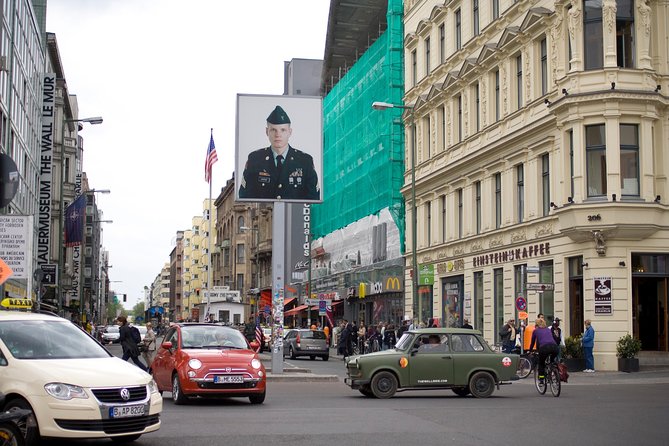
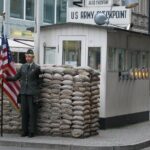
Checkpoint Charlie is one of Berlin’s most iconic Cold War sites, and it earns that status. Once a border crossing between East and West Berlin, it became a stage for standoffs and the drama of geopolitical pressure.
The tour covers key moments like the 1961 tank standoff between American and Soviet forces. You’ll also hear stories about daring escape attempts, plus background on the checkpoint’s role in the Cold War’s tense landscape. Near this site, there’s museum context on espionage and escape—helpful if you want to understand why Berlin was such a magnet for risk-taking.
Time is about 15 minutes. That’s just enough to connect the symbol to the reality behind it, especially with an English guide walking you through what to notice.
Memorial of the Berlin Wall (Bernauer Strasse): Escape Stories You Can Feel
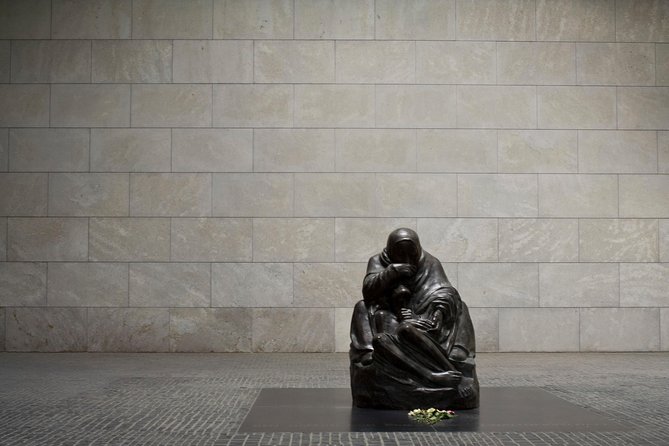
If there’s one stop that can change how you see Berlin, it’s Bernauer Strasse. This is where escapes happened in dramatic ways, with families and individuals risking everything to cross the wall.
The tour leads you through the Wall Memorial area and preserved sections of the Wall plus original watchtowers. You’ll also hear about escape tunnels—like Tunnel 57 and Tunnel 29—treated here as symbols of hope and resistance. This is the longest stop on the day at 35 minutes, and you can feel why: the site asks you to slow down, even if the schedule still moves.
The value isn’t only the facts. It’s the emotional structure of the tour: you don’t just see a barrier; you learn what it meant to human lives and choices.
Brandenburg Gate and Unter den Linden: Reunification Through One Monument
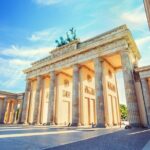
Brandenburg Gate is one of Berlin’s most recognizable landmarks, and the tour uses it as a “then and now” bridge. Built in the late 18th century with its famous neoclassical design and Quadriga, it originally functioned as a grand city entrance.
During the Cold War, it became a symbol of division. You’ll learn how it sat near the Berlin Wall and was closed off and surrounded by barbed wire. After the Wall fell in 1989, it reopened and became a symbol of reunification.
This stop is brief—around 12 minutes—but the location gives you immediate context. You’ll get views tied to Unter den Linden Boulevard and the Reichstag direction, so you can start building your mental map of central Berlin.
Bebelplatz and Gendarmenmarkt: From Censorship to Culture Squares
Two final stops give your day more balance, moving from oppressive Nazi-era memory to Berlin’s cultural stage.
At Bebelplatz, the focus is on the 1933 book burnings—Nazi students setting fire to thousands of books. Today, there’s a glass-paneled memorial exhibit under the square with empty shelves, designed to symbolize the lost works and destroyed knowledge. It’s a direct reminder that censorship is a physical act, not just an idea.
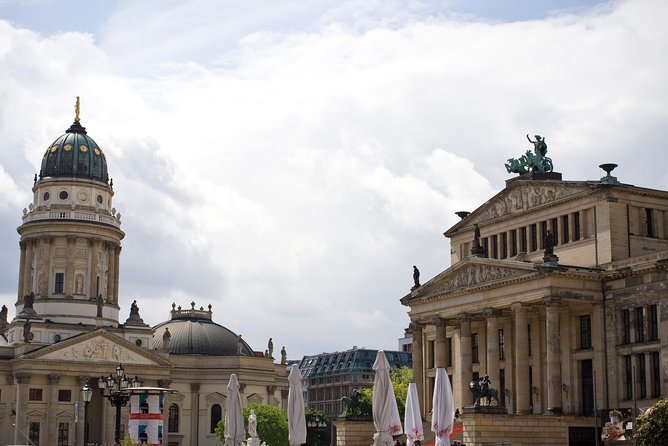
Then you’ll end at Gendarmenmarkt, one of Berlin’s prettiest squares, framed by architecture like the Berlin Cathedral (Berliner Dom) and the Konzerthaus, plus the French and German Churches. This is the place where the day shifts into a lighter rhythm: space for photos, a relaxing walk, and a sense of how Berlin wants to be seen now.
Time here is about 16 minutes, so it works as a graceful finish before you head back toward your ship.
Who This Tour Fits Best (and Who Might Want a Different Approach)
This is a strong match if:
- You want a history-focused Berlin day and like your stops tied to meaning, not just landmarks.
- Your group values a private guide and hates scrambling.
- You’re okay with short visits in many locations as long as the narrative is strong.
You might think twice if:
- You prefer long museum time at a slower pace.
- You’re traveling with someone who needs lots of sitting breaks, since the schedule has many “grab-and-go” moments.
- You want a purely scenic Berlin day. This tour is heavier on political memory than on casual wandering.
My Booking Advice: Should You Go?
I’d book this if you’re visiting Berlin from Warnemünde and you want one guided day that covers the big political chapters without guesswork. The strongest reason is guide quality—people come away praising guides like Phil and Brian Bell for making World War II and Germany’s path easier to follow, even when the subject matter is tough.
If you go, plan for the day to feel intense in short bursts. Bring comfortable footwear, and plan your own snacks or meals since food and drinks aren’t included. With that in mind, you’ll leave with a much clearer Berlin story than you’d get from a grab-bag bus tour.
FAQ
What is the duration of the Berlin shore excursion from Warnemünde?
It runs about 12 hours.
What’s the price per person?
The listed price is $1,075.31 per person.
Is this tour private?
Yes. It’s a private tour/activity, and only your group participates.
Do I get picked up at the cruise port, and how does the meeting work?
A driver meets you dockside in a modern air-conditioned vehicle/minibus, then transports you to Berlin to meet your expert guide. Pickup and drop-off are included.
What language is the tour guide?
The tour is offered in English.
Is food included?
No. Food and drinks are not included.
Is admission included for the major stops?
For the listed stops, admission tickets are shown as free.
Is the tour focused only on one period of history?
It covers Berlin and German history from earlier periods through the Nazi era and into the Cold War and reunification.
What’s the cancellation option if plans change?
You can cancel up to 24 hours in advance for a full refund.