REVIEW · ATHENS
Essential Athens Full Day Private Tour – Best Shore Excursion
Book on Viator →Operated by Private Greece Tours · Bookable on Viator
Athens is best when you control the day. This private 8-to-9-hour shore excursion is built for your schedule, with hotel or Piraeus port pickup and an A/C vehicle that keeps you comfortable from first stop to last. You also get skip-the-line ticket purchasing arranged in advance, so you spend more time looking at stone and less time waiting.
I especially like two things: you can move fast when you need to (cruise days, tight timelines), and you can slow down when Athens turns into a slow, hot day. Plus, the route hits both the big-name classics and the “you’ll remember this” places like the Ancient Agora and the Acropolis Museum.
One thing to consider: the price covers the private transport and planning, but site entrance fees aren’t included, and a driver can’t enter the archaeological sites—if you want a fully guided walk inside, there’s an added cost for a licensed guide.
In This Review
- Key things that make this tour work
- Price and what you truly get for $229.87
- Hotel or port pickup: the real start of your day
- The Acropolis: sacred rock, classic views, and a ticket strategy
- Temple of Olympian Zeus: where Rome tried to outshine Athens
- Panathenaic Stadium: ancient sports, modern atmosphere
- Lycabettus Hill: the view that connects the whole route
- Syntagma Square and the Unknown Soldier: Athens today
- The neo-classical “trilogy” area: University, Academy, Library views
- Ancient Agora and the Museum: the Athens behind the Athens
- Monastiraki: shopping, snacks, and the streets that feel alive
- Acropolis Museum: where the stones explain themselves
- Who this private Athens tour fits best
- Should you book this tour?
- FAQ
- How long is the Athens private tour?
- What time does the tour start?
- Is pickup included?
- Is this tour private?
- Are entrance fees to sites included?
- What does skip-the-line mean here?
- Do I need to pay for the Acropolis Museum?
- Can a licensed tour guide join us inside the archaeological sites?
- Is food included?
- What if weather is bad?
Key things that make this tour work
- Private pacing: Your stops and timing can be adjusted to your group
- Pickup from your exact area: Athens center, Athens hotels, or Piraeus cruise port
- A/C comfort: A smart choice for summer heat and sudden weather changes
- Skip-the-line ticket purchasing: You still pay admissions, but you avoid ticket chaos
- Big hits plus the “why”: Acropolis, Agora, and the Acropolis Museum are all in the mix
Price and what you truly get for $229.87

At $229.87 per person, this is not the cheapest way to see Athens. But you’re paying for privacy, direct pickup, and a day that’s designed to reduce wasted time—especially important if you’re on a cruise stop and you have zero margin for delays.
Here’s the trade-off: you’re not just buying a driver and a van. You’re also buying advance planning, parking included, and a smooth flow between sites. The entrances themselves are extra, and those can add up, especially if you want the Acropolis Museum and both Agora stops.
A practical way to think about value: if you’re a small group or you hate standing in lines, the private setup tends to feel fair. If you’re traveling solo on a shoestring, you might prefer a cheaper group tour and accept the crowding and fixed timing.
You can also read our reviews of more private tours in Athens


Hotel or port pickup: the real start of your day
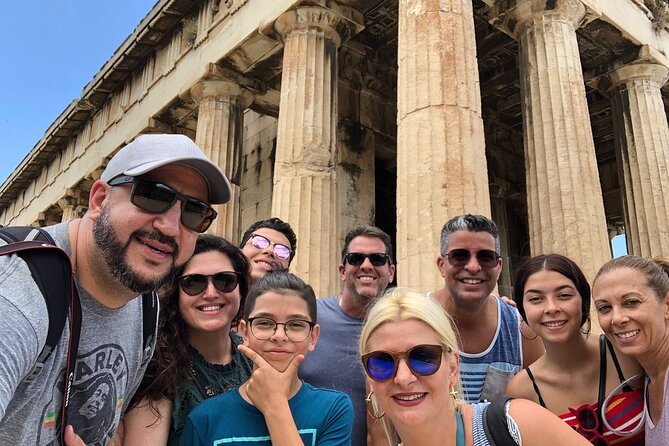
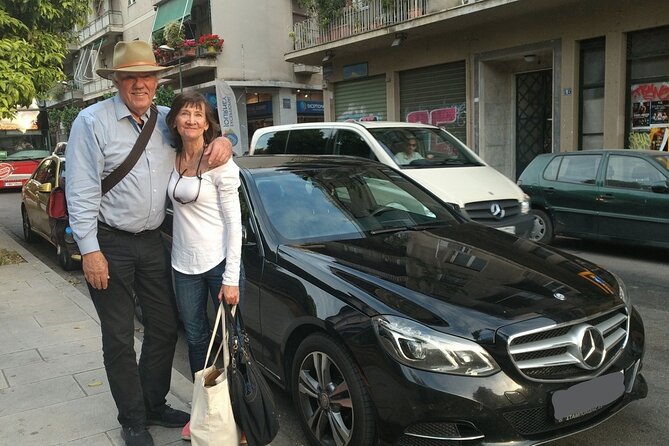
The day starts with pickup at an agreed time, with flexible pickup windows on request. You can be picked up from Athens city center hotels or residences, and from Piraeus cruise port as well, which is exactly what you want on a shore day.
This matters because Athens traffic and parking can eat your morning. With pickup organized for your location, you lose less time and you spend more time inside the sites that have long lines. The vehicles are described as A/C, non-smoking, insured, and certified for tourist use.
Also helpful: child seats are available on request, and the service is family friendly, with the ability to modify the tour for kids. If you’re traveling with anyone who gets cranky in long walks, this kind of private planning can make the day much more enjoyable.
The Acropolis: sacred rock, classic views, and a ticket strategy

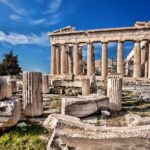
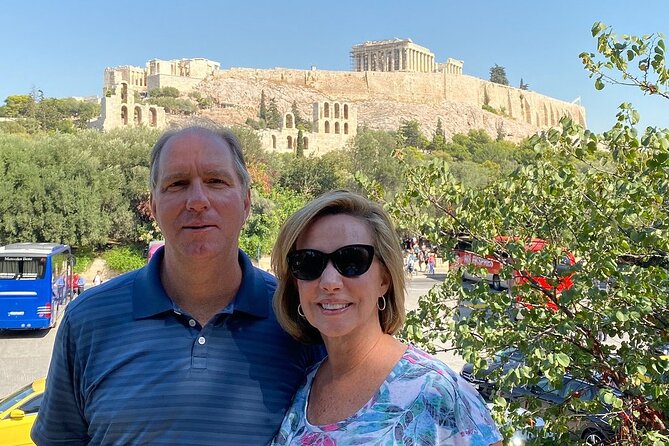
The Acropolis stop is built to give you the core monuments without turning it into a sprint. You’ll spend about 1 hour 30 minutes here, and the tour focuses on the story of Athens as a religious and civic center.
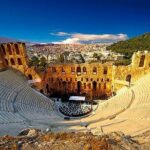
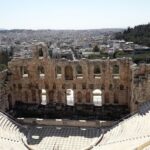
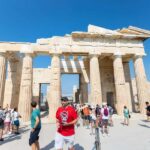
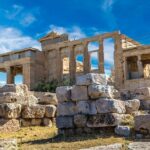
You’ll see the Parthenon, dedicated to Athena (Parthenos), plus the Propylea, the monumental entrance to the sacred area. From there, the route brings you to the Temple of Athena Nike and the Erechtheion, including its famous female figures-statues (Caryatides). Then the tour continues through the Odeum of Herodus Atticus and the Theatre of Dionysus—described as the first theatre in the whole world—ending near the Areopagus (Mars Hill).
The big practical advantage is timing and ticket handling. Skip-the-line service is offered for purchasing the appropriate entrance tickets in advance, so you’re not stuck at the most frustrating part of the day. Still, Acropolis admission itself is extra (listed as €30 per person), so you’ll want to plan for that cost early.
One more key point: your driver provides commentary during the drive, but the driver can’t enter archaeological sites. The tour can arrange a private licensed guide inside the sites for an additional 350€, depending on availability. If you want someone walking you through every detail at ground level, this is the option to consider.
Temple of Olympian Zeus: where Rome tried to outshine Athens
After the Acropolis, you’ll shift to the Temple of Olympian Zeus. This stop is shorter—about 30 minutes—but it’s a worthwhile contrast.
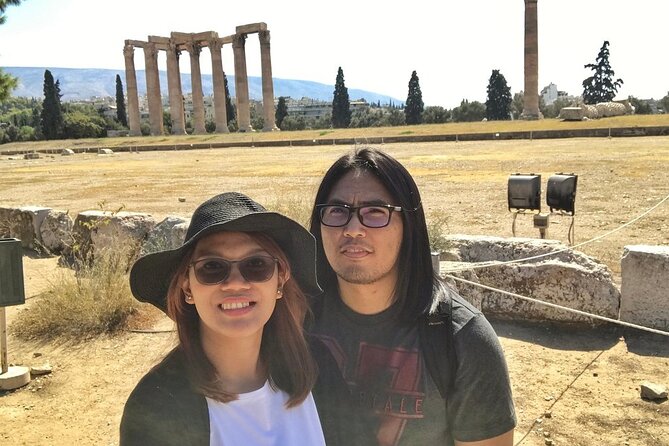
The temple dates to 124–132 AD and once had a dramatic column layout: tripteral octastyle on the narrow sides and dipteral eikosastyle on the long sides. Sixteen columns survive today, thirteen on the east side, described as intact. It also once housed a chryselephantine (gold and ivory) statue of Zeus—an enormous clue that Athens was never the only player in Greek religious life.
This stop is also a good “breather.” You’re moving from the heights of the Acropolis to a more open, city-level view. In hot weather, that change of pace helps.
As with most sites, you’ll likely pay admission if you choose to visit (the Temple of Zeus entrance is listed as optional and shown as €20 per person). If you’re trying to budget, you can decide whether to include it based on how many paid entrances you want.
Panathenaic Stadium: ancient sports, modern atmosphere
Next is the Panathenaic Stadium, with about 30 minutes allotted. It started as a natural hollow between the hills of Agra and Ardettos and was transformed into a stadium by Lykourgos in 330–329 BC for the Great Panathinaea festivities.
Later, between 140 and 144 AD, Herodes Atticus restored it, giving it the horseshoe construction form found at the 1870 excavation. The track is listed as 204.07 meters long and 33.35 meters wide, and it’s believed the seating capacity was around 50,000.
Why I think this stop is more than a quick photo break: you’re looking at a place where sport was tied to ceremony and civic identity. It also helps you understand Athens as a living city, not just a museum of ruins.
Admission is listed as free for this stop, which is a nice win when you’re managing add-on costs for the day.
A few more Athens tours and experiences worth a look




Lycabettus Hill: the view that connects the whole route

If you want one spot that makes Athens feel like a real place, not just a list of monuments, it’s Lycabettus (Mount Lycabettus). You’ll get about 30 minutes here, including time for the viewpoint.
Lycabettus is listed as the highest point of Athens at 277 meters above sea level. From the top, you should get panoramic views of the Acropolis, Temple of Olympian Zeus, Panathenaic Stadium, Ancient Agora, and the city. You’re also reminded Athens is surrounded by sea, with views across the Aegean.
On top of the hill is the Greek Orthodox church of Agios Georgios (St. George). Even if you’re not a museum person, a viewpoint stop can be the moment you start “seeing” the city in 3D.
Practical tip: this is the kind of place where a short, weather-dependent plan makes sense. If clouds roll in or visibility drops, the view may not feel as dramatic—though the stop itself still gives you a sense of the geography.
Syntagma Square and the Unknown Soldier: Athens today
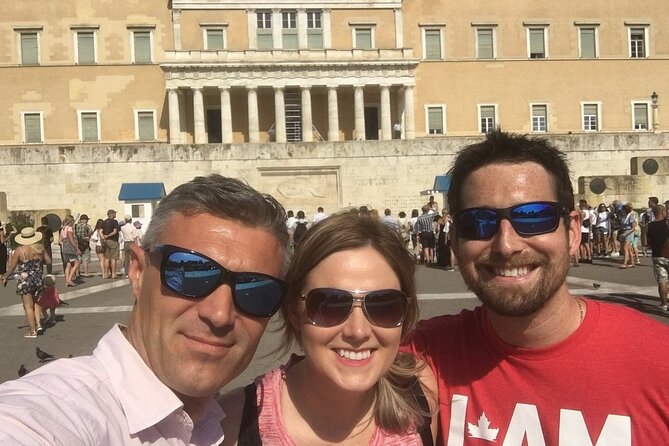
You’ll also spend time at Plateia Syntagmatos (Constitution Square), about 15 minutes, in front of Athens’ parliament building. This is one of the city’s big public plazas, lined with white marble and statues, and it’s where many major streets begin.
Right after that, there’s the Monument to the Unknown Soldier (the Tomb of the Unknown Soldier), also about 15 minutes. It’s a war memorial dedicated to Greek soldiers killed during war, sculpted between 1930 and 1932 by sculptor Fokion Rok. The tomb is guarded 24/7 by the Evzones (Presidential Guards).
This is a smart addition if you’re worried about a day that’s too ancient-only. It gives you Athens as a modern capital, where ceremonial tradition still plays a visible role.
The neo-classical “trilogy” area: University, Academy, Library views
The route also includes stops around the University of Athens area, the Academy of Athens, and the National Library of Greece. These are described as part of a famous trio of neo-classical buildings in the city center.
The National and Kapodistrian University of Athens is one of the major public universities. The Academy of Athens is described as Greece’s national academy and highest research establishment, established in 1926. The National Library rounds out the set, and the buildings themselves are landmarks worth a quick look.
This is not usually the highlight for people who crave only ruins. But it’s useful for getting your bearings. Athens has a layered look—ancient marble up top, then neoclassical order and civic buildings in the middle.
If you want to keep the day moving, this kind of quick architectural stop makes sense. You get context without burning your whole afternoon.
Ancient Agora and the Museum: the Athens behind the Athens
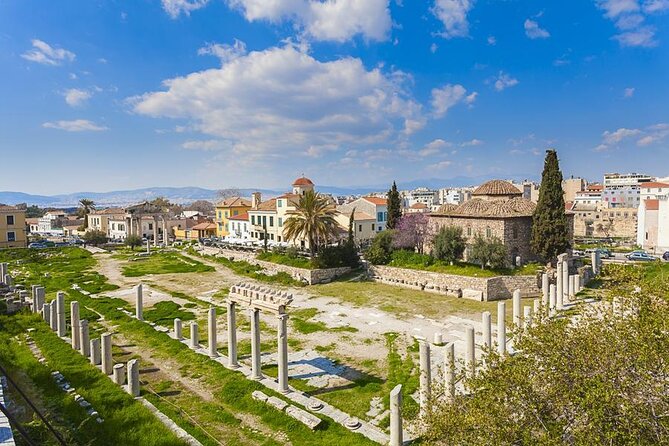
The day’s second major historical core is the Ancient Agora area. You’ll spend about 1 hour 30 minutes here. The Agora was described as the heart of ancient Athens—political, commercial, administrative, and social activity—with religious and cultural roles and as a seat of justice.
The tour frames the Agora through excavation history too: Greek Archaeological Society work starting in 1859–1912, German Archaeological Institute excavations in 1896–97, and later American School of Classical Studies systematic excavations supported by J. Rockefeller. Work resumed after 1945 and is still continuing.
Then you can add the Museum of the Ancient Agora, about 1 hour. It’s housed in the reconstructed Stoa of Attalos, originally erected in the 2nd century BC as a gift to Athens. The museum gallery includes archaeological finds from Neolithic to post-Byzantine and Ottoman periods, so it’s not limited to one ancient moment.
Important practical note: admission here is listed as not included (shown as €20 per person for the Ancient Agora and Museum of Agora). If you’re choosing between more paid sites, decide based on your interest level in how artifacts connect to what you saw outside.
If you like the Acropolis but want the real day-to-day Athens story, this is where the trip turns from spectacle into understanding.
Monastiraki: shopping, snacks, and the streets that feel alive
No full Athens day is complete without a neighborhood moment, and Monastiraki is exactly that. You’ll have about 1 hour here, and it’s known for the flea market area, with cafes and shops selling souvenirs.
This stop also pairs well with hunger and heat. You’re in a place with plenty of traditional Greek tavernas and restaurants, and some streets offer Acropolis views. The tour keeps it flexible since the admission is listed as free for this portion.
I like Monastiraki because it’s not just a stop—it’s a chance to catch the Athens rhythm. You can browse without committing to a museum ticket, and you can plan your breaks around your own energy level.
Acropolis Museum: where the stones explain themselves
The final anchor of the day is the Acropolis Museum, with about 1 hour allotted. It’s described as one of the most important museums in the world and focused specifically on findings from the archaeological site of the Acropolis and surrounding slopes.
The big idea: the museum is built to house every artifact found on the rock and the slopes, spanning from the Greek Bronze Age through Roman and Byzantine Greece. That range helps you understand that Athens wasn’t frozen in one era.
Museum admission is listed as not included (shown as €20 per person for the Acropolis Museum). If you’re deciding how to spend your money, this is often where your ticket dollars feel most educational.
After a day of walking around temples and ruins, the museum gives you a clearer mental map of what you saw. It’s the place where details start to click.
Who this private Athens tour fits best
This is a strong choice if you’re doing Athens as a cruise shore stop or you just want to control timing. Reviews tied to this style of private day consistently mention guides and drivers being punctual and the A/C car being a relief on hot days.
It’s also a good match if you want the main monuments plus the less obvious stops: Ancient Agora plus the Museum of Agora, then Monastiraki and the Acropolis Museum. That mix helps you avoid the common problem of seeing only the tallest highlights and missing the city behind them.
If you’re traveling with kids, the tour is described as family friendly and can be modified for children. If you want a more formal guide experience inside the sites, you’ll want to consider the optional licensed guide add-on.
And if you prefer zero waiting lines: skip-the-line ticket purchasing plus private pickup and transport are built around that idea.
Should you book this tour?
Book it if you want an easy, time-smart day with private pickup, A/C comfort, and a clear path through Athens highlights that goes beyond just photos. The value is strongest for small groups who don’t want to gamble on lines, get bounced around by other travelers, or spend precious hours figuring out where to go next.
Consider skipping (or modifying your expectations) if you’re comfortable doing Athens solo, you’re happy with group logistics, or you’re trying to keep total costs low once you add site admissions. Also consider the licensed guide option if you care about deep interpretation while you’re inside the sites—your driver can’t enter archaeological areas, so interpretation inside depends on that added arrangement.
If you want a smooth Athens day that feels like it was planned for you rather than dumped onto you, this private route is a strong bet—especially when the weather is hot and time is short.
FAQ
How long is the Athens private tour?
The duration is about 8 to 9 hours.
What time does the tour start?
The start time is listed as 8:00 am.
Is pickup included?
Yes. Pickup and return are offered from Athens hotels/residences in Athens center and from the Piraeus cruise port area.
Is this tour private?
Yes. It’s a private tour, and only your group participates.
Are entrance fees to sites included?
No. Entrance fees are not included. The Acropolis admission is listed as €30 per person, and other optional sites also have separate fees.
What does skip-the-line mean here?
The tour includes skip-the-line service to purchase the appropriate entrance tickets in advance, which helps reduce waiting time. You still pay the site admissions.
Do I need to pay for the Acropolis Museum?
Yes. Acropolis Museum admission is listed as optional and priced at €20 per person, and it is not included.
Can a licensed tour guide join us inside the archaeological sites?
A licensed tour guide inside the sites is not included by default. It can be arranged for an additional 350€ depending on availability.
Is food included?
No. Food and drinks are not included, though child bottled water is included.
What if weather is bad?
This experience requires good weather. If it’s canceled due to poor weather, you’ll be offered a different date or a full refund.